The United States needed buildings fast after World War II. It got them. New construction methods sped things up, government expanded, and budgets followed. The GSA undertook more than 700 building projects between 1960 and 1976, many of them in modern styles.
Modernism had arrived with actual ideas. Early modernists chose clean geometry, bare surfaces, and little ornament because they believed buildings should work differently. Once the building boom got moving, those choices became easy to copy and the beliefs behind them didn't. The rectangle had a terrific few decades.
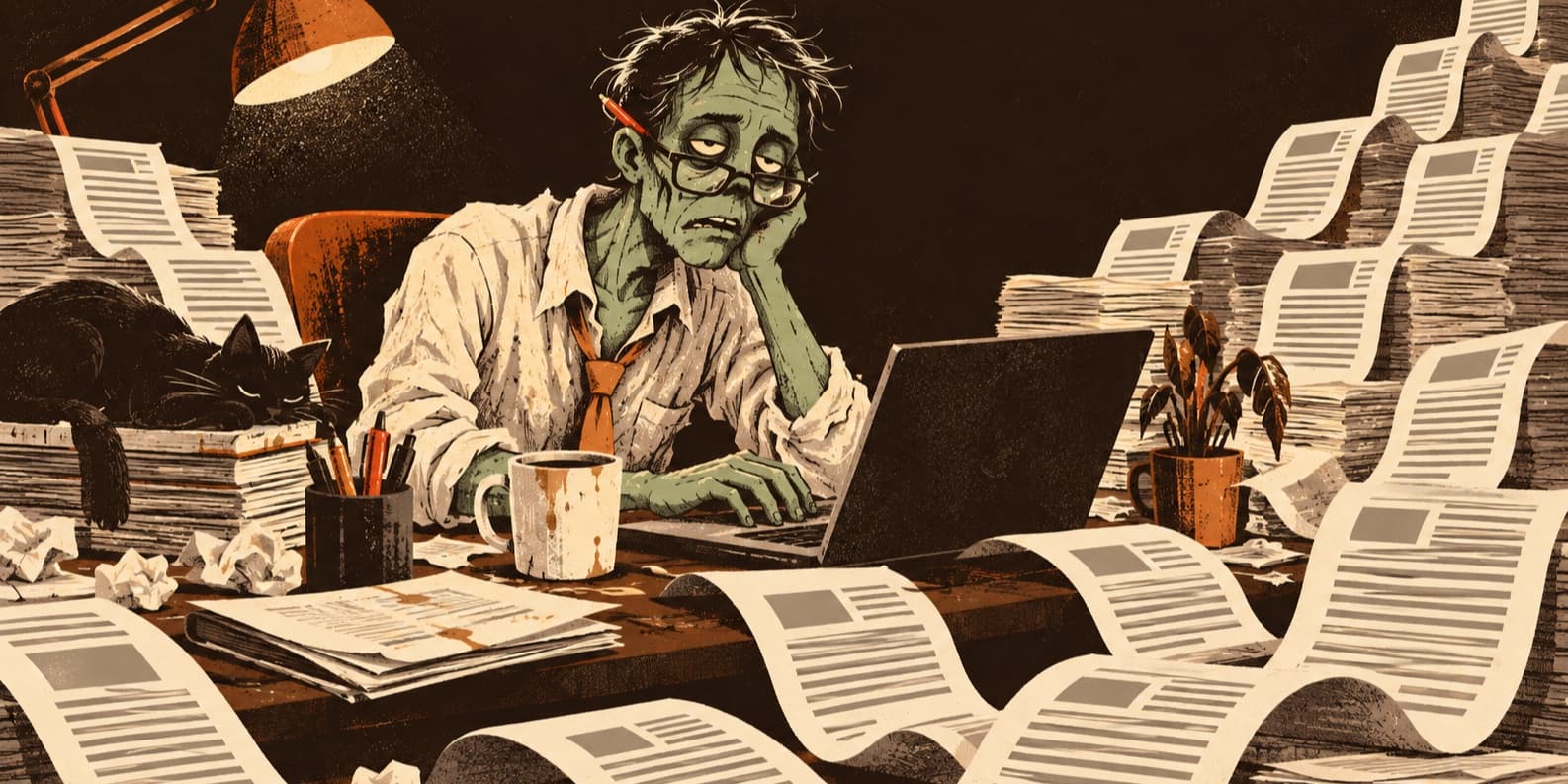
The generic results were zombie buildings. They function. They meet code. They could also belong to a bank, an insurance company, a county office, or the place where office chairs go to appeal parking tickets. The visible pattern survived after the intent disappeared.
Content is heading into its own building boom.
AI can produce the visible parts of an article almost instantly: title, introduction, headings, examples, conclusion, FAQ, metadata. Most organizations still haven't worked out how to produce the judgment that made the article worth commissioning. We don't think AI writing is the problem. We think cheap production is about to expose how little editorial intent was present in a lot of content systems to begin with.
Every topic now gets its own gray box
The zombie article is already familiar. Its title promises a definitive guide. The introduction explains that the subject has become important. Five headings cover the expected advice. The conclusion recommends strategy, consistency, and the right tools, three sturdy nouns that have escorted many a tired article safely to 1,500 words.
Swap the company name and examples. Nothing breaks.
Search incentives and cheap outsourced writing created plenty of this before generative AI. The difference now is throughput. A thin brief used to buy one thin article. It can buy fifty before the person who requested them has finished the meeting where everybody agreed to "test AI."
The model is giving the brief what it asked for. A broad topic produces the probable answer, built from patterns that already exist. That can be useful for mapping a subject. It can't decide what your company has noticed that the rest of the category missed.
AI makes the gap between coverage and judgment harder to ignore. Facts are available. Competitor pages are available. A competent explanation is getting cheaper by the week. If the article's value came from arranging common information into a familiar shape, the moat has had an unfortunate encounter with a puddle.
Watch the details that don't matter
Picture an AI-generated image with a green cup in the corner. Make the cup blue. If the work loses nothing, the color was never doing anything.
Business content is full of green cups.
The founder in the opening could run a SaaS company or a dental group. The quoted statistic could move ten points without touching the argument. The customer example adds a name and industry, then behaves exactly like every other example chosen to prove the conclusion waiting at the end.
Specific-looking isn't the same as specific. A real detail puts pressure on the rest of the piece. It changes the claim, narrows who the advice applies to, creates an exception, or forces the writer to admit that the neat answer doesn't hold.
This gives us a useful edit. Change the anecdote, example, company, and conclusion. What else has to move? If the answer is nothing, those parts are decorating the article. The draft may be accurate and readable. It still hasn't earned its square footage.
In plain English
If a detail can change without forcing the argument to move, it is decoration.
The pipeline assumes everything deserves to live
AI also moved the quality filter.
A content team might once have collected 20 ideas and produced two because research and writing were expensive. Most weak ideas died as rows in a spreadsheet. Nobody mourned. There wasn't a featured image yet.
Now the team can draft all 20. By the time anybody has to say no, each idea has a title, a URL slug, and several hundred perfectly respectable words. Killing it feels wasteful, even if its production cost was close to zero.
When teams can build all 20 ideas, filtering happens after the build, when saying no is harder. Content systems have the same problem. Most of them encode movement. Keyword becomes brief, brief becomes draft, draft becomes published page. A stopped item looks like a failure.
We should be much more suspicious of a content operation where everything ships.
The editor's job has changed accordingly. Sentence cleanup still matters, but the expensive decision now comes earlier and later at once: is there an idea here, and did the finished piece deliver it? The difference between a topic and an actual point doesn't fit into a jaunty checklist.
Sometimes the answer should be no after the draft is complete. That doesn't mean the process failed. It means somebody used it.
A style guide scales the easiest part
Most content systems are opinionated about the surface. They specify tone, sentence length, terminology, heading depth, link count, CTA format, and which punctuation mark has recently become evidence of a robot.
Keep those rules. They prevent drift. They also describe the part competitors can see.
The system needs opinions about the work underneath: what the company believes, which evidence it trusts, which claims it refuses to make, what the reader is deciding, and what would make a draft unpublishable. Those choices have to affect research and selection. Applying them during the final edit is like adding "local character" to a finished office block by painting one wall teal.
The better goal is to scale intent instead of consistency. Consistency makes the publication recognizable. Intent makes the individual article fit its purpose.
The difference shows up in the brief. "Write about AI content quality" hands the model a subject. A working brief has a claim somebody could reject, evidence that changed our view, a reader facing a particular decision, and a boundary around what we can't honestly say. We don't need every brief to sound grand. We need it to contain a decision.
Cheap drafts should create expensive choices
There's a better use for the savings.
At Stripe, an AI-assisted opening animation went through 56 versions before the team considered it right. Version one arriving quickly wasn't the achievement. The team could inspect far more of the possibility space, reject almost all of it, and keep working until the result carried the care they wanted.
Content teams can use the same economics. Try opposing arguments. Pull product data before settling for the industry statistic everybody cites. Call the customer whose result complicates the case. Commission the odd visualization that explains the mechanism better than another section of prose. Let four structures lose.
That will produce some work nobody sees. Good. Efficiency is a strange goal for the part of the process where taste gets exercised. If every generated angle survives, we didn't explore the space. We ran a merge.
AI has lowered the cost of putting up another content building. The internet will get many millions of them, all structurally sound enough and finished in the same tasteful gray.
We'd rather use the savings on the parts that make somebody stop and think: this could only have come from here.
Want this working on your site, not just your reading list?